How to Calculate EMI: The Formula, Real Examples, and What Banks Won't Tell You
Here's the moment that changes how you think about loans: you borrow ₹50 lakh for a home, and twenty years later, you've paid back ₹1.04 crore. That extra ₹54 lakh? Pure interest. It's more than the price of a decent apartment in many Indian cities. And yet most borrowers never do this math before signing.
I'm not saying loans are bad — they're often necessary, and leverage can be smart. But understanding exactly how your EMI is calculated gives you a kind of clarity that banks would rather you didn't have. When you see the actual numbers, you start making different decisions about tenure, prepayment, and how much to borrow in the first place.
So let's break this down. Not the textbook version with jargon — the real version, with actual numbers you can verify with our EMI calculator.
The EMI formula (it's simpler than it looks)
Every bank in the world uses the same formula to calculate your EMI. There's no secret sauce, no proprietary algorithm. It's pure math:
Three variables. That's all it takes to determine a number that'll leave your bank account every month for years — sometimes decades. Let me translate:
- P (Principal) — The total amount you're borrowing. Not the property value or car price, but what you actually need from the bank after your down payment.
- r (Monthly interest rate) — Your annual interest rate, divided by 12, then divided by 100. So 8.5% annual becomes 0.00708 per month. This tiny-looking number is where banks make their money.
- n (Tenure in months) — How many months you'll take to repay. A 20-year loan means n = 240. A 5-year car loan means n = 60.
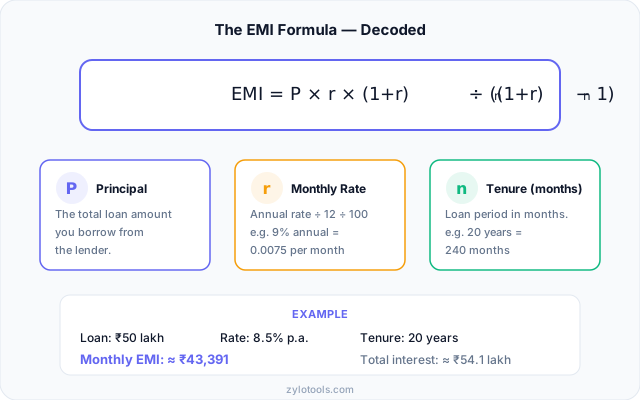
The intuition behind this formula: it calculates the exact fixed payment that will reduce your outstanding balance to zero by the end of the tenure, while accounting for interest that accrues every single month on whatever balance remains. The (1+r)n part handles the compounding — it's what makes the math work across time.
You don't need to calculate this by hand. Our EMI calculator does it instantly. But understanding what's happening under the hood helps you make smarter borrowing decisions.
Let me walk through a real calculation
Let's take the most common scenario in India: a home loan. Say you're buying a ₹65 lakh apartment, putting ₹15 lakh down, and borrowing ₹50 lakh at 8.5% for 20 years.
Step 1: Convert annual rate to monthly
Annual rate = 8.5%
Monthly rate (r) = 8.5 / 12 / 100 = 0.007083
Step 2: Convert tenure to months
Tenure = 20 years × 12 = 240 months
Step 3: Plug into the formula
EMI = 50,00,000 × 0.007083 × (1.007083)240 / ((1.007083)240 - 1)
EMI = 50,00,000 × 0.007083 × 5.4396 / (5.4396 - 1)
EMI = 50,00,000 × 0.03854 / 4.4396
EMI = ₹43,391 per month
Step 4: Calculate total cost
Total amount paid = ₹43,391 × 240 = ₹1,04,13,840
Total interest paid = ₹1,04,13,840 - ₹50,00,000 = ₹54,13,840
Now let's do a car loan: ₹8 lakh at 10% for 5 years.
Monthly rate = 10 / 12 / 100 = 0.00833
Tenure = 60 months
EMI = 8,00,000 × 0.00833 × (1.00833)60 / ((1.00833)60 - 1)
EMI = ₹16,997 per month
Total paid = ₹10,19,820. Total interest = ₹2,19,820. For a car loan, that's about 27% extra — less painful than a home loan because the tenure is shorter.
Here's a comparison across scenarios (for a $200,000 / ₹50 lakh equivalent loan):
| Loan Type | Amount | Rate | Tenure | EMI | Total Interest |
|---|---|---|---|---|---|
| Home Loan | ₹50L | 8.5% | 20 yrs | ₹43,391 | ₹54.1L |
| Car Loan | ₹8L | 10% | 5 yrs | ₹16,997 | ₹2.2L |
| Personal Loan | ₹5L | 14% | 3 yrs | ₹17,089 | ₹1.15L |
| Home Loan (US) | $200K | 6.5% | 30 yrs | $1,264 | $255K |
Run your own numbers with the EMI calculator — it shows you the full amortization schedule too.
What most people don't realize about EMI
Here's the thing that trips up almost every borrower: your EMI stays the same every month, but what's inside it changes dramatically over time.
In the early years of a loan, most of your EMI goes toward interest. The principal barely moves. It's like running on a treadmill — you're paying, but the debt isn't shrinking much. Then gradually, as the outstanding balance decreases, the interest portion shrinks and more of your payment goes toward actual repayment.
Let's look at our ₹50 lakh home loan example:
- Month 1: Out of ₹43,391 EMI → ₹35,417 is interest, only ₹7,974 reduces your principal
- Month 120 (year 10): → ₹24,850 is interest, ₹18,541 goes to principal
- Month 240 (final year): → ₹305 is interest, ₹43,086 goes to principal
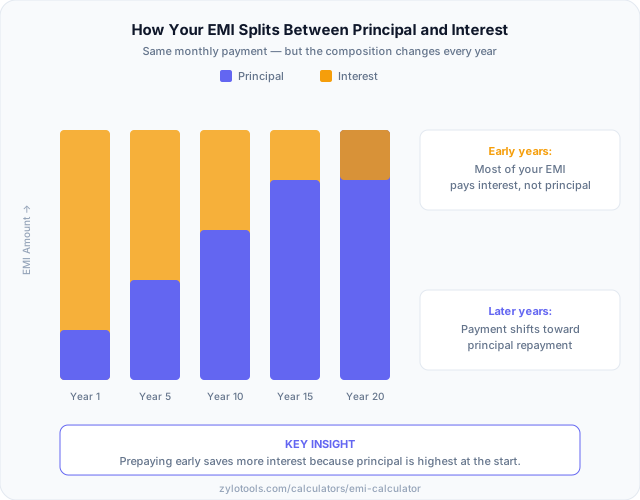
This is exactly why prepaying early in the loan saves you so much. When you reduce the principal in year 2 versus year 15, the interest savings cascade across all remaining months. It's compound interest working in your favor for once.
Think of it this way: every ₹1 lakh you prepay in year 1 of a 20-year loan at 8.5% saves you roughly ₹2.5 lakh in interest over the remaining tenure. That same prepayment in year 15 saves you maybe ₹40,000. The math is ruthlessly clear — prepay early if you can.
The tenure trap — lower EMI isn't always better
Banks love offering longer tenures. "Your EMI will be so comfortable," they'll say. And they're right — it will be lower. What they don't emphasize is how much more you'll pay in total.
Let's look at the same ₹50 lakh loan at 8.5% across different tenures:
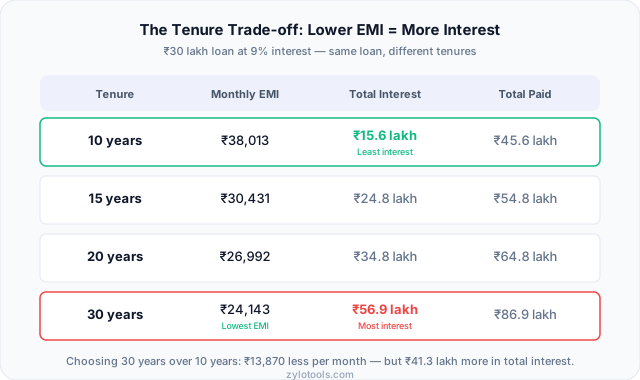
| Tenure | Monthly EMI | Total Interest | Total Paid |
|---|---|---|---|
| 10 years | ₹61,996 | ₹24.4L | ₹74.4L |
| 15 years | ₹49,236 | ₹38.6L | ₹88.6L |
| 20 years | ₹43,391 | ₹54.1L | ₹1.04Cr |
| 30 years | ₹38,446 | ₹88.4L | ₹1.38Cr |
Look at that 30-year column. You save about ₹5,000 per month compared to the 20-year option, but you pay ₹34 lakh more in total interest. That ₹5,000 monthly "savings" costs you ₹34 lakh over the life of the loan. Not a great trade.
The practical rule: choose the shortest tenure where the EMI doesn't exceed 40% of your take-home income. If your household brings in ₹1.5 lakh per month, keep your total EMI obligations under ₹60,000. This leaves room for emergencies, investments, and life.
Some people call this the 50/30/20 approach to loan affordability: 50% for needs (including EMI), 30% for wants, 20% for savings and investments. The EMI portion should never cannibalize all three buckets. Use our percentage calculator to work out your income ratios quickly.
How prepayment actually works
Prepayment is the single most powerful tool a borrower has. It's also the one banks are least enthusiastic about explaining. Here's how it works and when it makes sense.
When you make a prepayment — say you get a bonus and throw ₹3 lakh at your home loan — the bank gives you two options:
Option A: Reduce your EMI, keep the same tenure. Your monthly outflow decreases immediately. Good for cashflow, but you don't save as much on total interest because the loan still runs for the same duration.
Option B: Keep your EMI the same, reduce the tenure. Your monthly payment doesn't change, but the loan ends sooner. This saves significantly more interest because you're eliminating months of future interest accumulation.
Let's put numbers to it. On our ₹50 lakh / 8.5% / 20-year loan, suppose in year 3 you prepay ₹5 lakh:
| Option | New EMI | New Tenure | Interest Saved |
|---|---|---|---|
| Reduce EMI | ₹39,225 | 17 yrs remaining | ~₹5.8L |
| Reduce Tenure | ₹43,391 (same) | ~15.5 yrs remaining | ~₹9.2L |
Reducing tenure saves about ₹3.4 lakh more. Over 20 years and multiple prepayments, this difference compounds into serious money.
The one-extra-payment strategy: If you can make just one extra EMI payment per year (perhaps from a bonus or tax refund), you can shave 3-4 years off a 20-year loan and save ₹10-15 lakh in interest. It's one of the simplest financial moves with outsized returns.
One important note: check your loan agreement for prepayment charges. RBI has mandated that floating-rate loans cannot carry prepayment penalties. But fixed-rate loans and some older agreements may have charges of 2-4% on the prepaid amount. Always read the fine print.
Comparing loan types (what changes)
Not all loans are created equal. The EMI formula is the same, but the inputs — and the economics — vary dramatically across loan types. Here's what matters:
Home loans get the best deal: longest tenures (up to 30 years), lowest interest rates (currently 8-9.5% in India, 6-7.5% in the US), and tax benefits under Section 80C and 24(b). The asset typically appreciates. This is "good debt" if managed correctly.
Car loans are moderate: 3-7 year tenures, rates around 8-12%. The problem? Cars depreciate. By the time you finish paying, the car is worth 30-40% of what you paid. Don't stretch car loan tenure beyond 5 years — you'll owe more than the car is worth midway through.
Personal loans are the most expensive: 1-5 year tenures, rates from 10-24%. They're unsecured (no collateral), so banks charge a premium for the risk. Use these only for genuine needs and pay off as quickly as possible.
| Feature | Home Loan | Car Loan | Personal Loan |
|---|---|---|---|
| Interest Rate | 8–9.5% | 8–12% | 10–24% |
| Max Tenure | 30 years | 7 years | 5 years |
| Secured? | Yes (property) | Yes (vehicle) | No |
| Tax Benefits | Yes (80C + 24b) | No (personal use) | No |
| Asset Value | Appreciates | Depreciates | No asset |
Whatever loan type you're considering, run the numbers through our EMI calculator first. Seeing the total interest cost in black and white changes perspectives. For GST implications on loan processing fees, our GST calculator can help you figure the exact amount.
Tips I'd give to anyone taking a loan
After watching friends and family navigate loans — some smartly, some painfully — here's what actually matters:
1. Get quotes from at least 3-4 lenders. Interest rates vary by 0.5-1.5% between banks for the same borrower profile. On a ₹50 lakh home loan, even 0.25% less saves you about ₹3 lakh over 20 years. This includes comparing NBFCs and housing finance companies — they sometimes beat bank rates.
2. Look beyond the interest rate. Processing fees (0.5-1% of loan amount), legal charges, valuation fees, insurance requirements — these add up. A loan with 8.5% rate + 1% processing fee might cost more than 8.75% with zero processing fee, depending on tenure. Calculate the effective cost, not just the headline rate.
3. Understand fixed vs. floating rates. Floating rates move with the market — they can go up or down. Fixed rates stay constant but are typically 0.5-1% higher. In a falling rate environment, floating wins. In a rising rate environment, fixed protects you. Most Indian home loans are floating, linked to the repo rate.
4. Never borrow the maximum you qualify for. Banks will approve loans where EMI is up to 50-55% of your income. That's a recipe for financial stress. Keep it under 40%. Life throws curveballs — job changes, medical expenses, market downturns. You need breathing room.
5. Keep total EMI obligations under 40% of take-home income. This includes ALL loans — home, car, personal, credit card dues. If your take-home is ₹1.2 lakh, total EMIs shouldn't exceed ₹48,000. Use a percentage calculator to check your ratios.
6. Build a 6-month EMI reserve before taking the loan. If something goes wrong — job loss, illness, business downturn — you have a buffer. Missing EMI payments tanks your credit score and triggers penalty charges.
7. Consider the opportunity cost. That ₹43,391 monthly EMI over 20 years? If you had invested it in an equity SIP at 12% returns, it would grow to over ₹4 crore. Obviously you need a home to live in — but this perspective helps you borrow less and prepay more aggressively.
Frequently Asked Questions
What happens if I miss an EMI payment?
Missing an EMI triggers a late payment fee (usually 1-2% of the EMI amount or a flat charge). More importantly, it gets reported to credit bureaus like CIBIL, which drops your credit score. One missed payment can reduce your score by 50-100 points. If you miss 3+ consecutive payments, the loan is classified as NPA (Non-Performing Asset) and recovery proceedings can begin. If you foresee trouble, contact your bank proactively — most offer restructuring or moratorium options.
How do interest rate changes affect my existing EMI?
For floating-rate loans, when the repo rate changes, your bank adjusts your lending rate accordingly. Banks can either change your EMI amount (keeping tenure same) or change your tenure (keeping EMI same). Most banks default to adjusting tenure. This means in a rising rate environment, your loan tenure quietly extends — sometimes by years — without your EMI changing. Always ask your bank which approach they're using and whether you can switch.
Can I change my loan tenure mid-way?
Yes, most banks allow tenure modification, though policies vary. You can typically request to extend tenure (which reduces EMI) or shorten it (which increases EMI). Some banks charge a processing fee for this change. It's usually easier to reduce tenure through prepayments — same effect, no paperwork. If your income has increased significantly, shortening tenure through higher EMI is one of the best financial moves you can make.
Is there a penalty for prepaying my loan?
For floating-rate loans in India, the RBI has prohibited prepayment penalties since 2012. Banks cannot charge you anything extra for prepaying. For fixed-rate loans, penalties of 2-4% on the prepaid amount may apply. For loans taken before 2012 or from NBFCs, check your loan agreement carefully. In the US, some mortgages carry prepayment penalties for the first 3-5 years — this is called a "prepayment clause" and should be negotiated at origination.
How much loan can I afford based on my salary?
The standard guideline is that your total EMI payments (all loans combined) shouldn't exceed 40% of your net take-home salary. Banks may approve up to 50-55%, but that leaves no room for financial emergencies. For a salary of ₹1 lakh per month, keep total EMIs at or below ₹40,000. Also consider that your expenses grow over time — factor in inflation, lifestyle changes, and future obligations (children's education, parents' healthcare) before committing to a large EMI.
Is it better to take a loan or use savings?
It depends on the math. If your savings earn less than the loan interest rate (after tax), use savings to avoid the loan. If your investments earn more than the loan rate — and you have discipline to stay invested — taking the loan and keeping investments intact makes mathematical sense. However, for most people, the psychological burden of debt is real. A practical approach: use savings for high-interest loans (personal loans, credit cards) and take loans for low-interest needs (home loans, especially with tax benefits). Check our guide to investment tools for comparing returns.
Want to see your actual numbers?
Enter your loan amount, rate, and tenure. Your EMI calculates instantly — plus a full amortization breakdown.
Open EMI Calculator →