Temperature Conversion Made Simple: Celsius, Fahrenheit, and Kelvin
You're following a recipe from a British food blog that says to preheat the oven to 200°C. You stare at your American oven's dial, which only shows Fahrenheit. Or maybe you've just landed in Europe, checked your phone for the weather, and seen "18°" — is that cold? Do you need a jacket? Should you panic?
If you've ever felt a small wave of frustration trying to mentally convert between temperature scales, you're in good company. Most of us learned the formula once in school, promptly forgot it, and have been awkwardly Googling "72F in Celsius" ever since.
Here's the good news: you don't actually need to memorize the exact formula for everyday life. There's a shortcut that gets you close enough to make decisions — and for the times you need precision, that's what converter tools are for. But understanding why these scales exist (and why we're stuck with three of them) makes the whole thing click in a way that pure memorization never does.
Let's sort this out once and for all.
The Three Scales and Why They Exist
We didn't end up with three temperature scales because scientists enjoy making life complicated. Each one was designed to solve a specific problem, and each one does its job well — just in different contexts.
Celsius: The Water Scale
Anders Celsius, a Swedish astronomer, proposed his scale in 1742 with a beautifully simple premise: let water define everything. Set 0° where water freezes, set 100° where it boils (at standard atmospheric pressure), and divide the space between into 100 equal parts. Clean, logical, metric-friendly.
This is why Celsius dominates most of the world. It's intuitive for cooking, weather, and everyday life. If someone says it's 35°C outside, you know it's hot. If it's 0°C, you grab your heaviest coat. The anchor points just make sense because water is everywhere in our daily experience.
Fahrenheit: The Human Comfort Scale
Daniel Gabriel Fahrenheit developed his scale in 1724 using different anchor points — the coldest temperature he could reliably create in his lab (a salt-ice-water mixture, set as 0°F) and human body temperature (originally set at 96°F, later revised). The result is a scale where the 0-100 range neatly brackets most human-habitable outdoor temperatures.
There's actually a hidden logic here: each Fahrenheit degree is a smaller increment than a Celsius degree (1°F = 0.556°C), which means you get more granularity without resorting to decimals. When you're setting a thermostat or describing weather, the difference between 71°F and 73°F is perceptible in a way that "21.7°C vs 22.8°C" doesn't feel as natural to express.
Kelvin: The Absolute Scale
Lord Kelvin (William Thomson) proposed his scale in 1848 for a completely different audience: scientists who needed a temperature scale with a meaningful zero. In Celsius, 0° is just where water freezes — a useful reference but physically arbitrary. In Kelvin, 0 means zero thermal energy. Nothing can be colder. Molecular motion has effectively stopped.
Kelvin uses the same degree size as Celsius (so 1K increment = 1°C increment), but starts at absolute zero (−273.15°C). This makes it indispensable for physics, chemistry, and engineering where temperature ratios need to mean something. You'll never encounter Kelvin on a weather app, but it's everywhere in laboratories and scientific papers.
The Conversion Formulas (and the Shortcut You'll Actually Use)
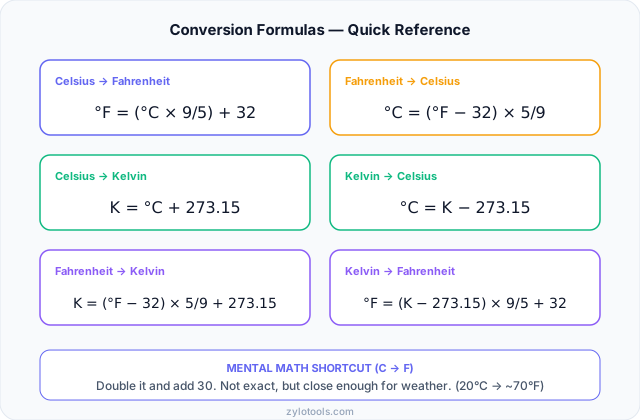
Let's get the official formulas out of the way first. These are mathematically exact:
Celsius ↔ Fahrenheit:
- °F = (°C × 9/5) + 32
- °C = (°F − 32) × 5/9
Celsius ↔ Kelvin:
- K = °C + 273.15
- °C = K − 273.15
Fahrenheit ↔ Kelvin:
- K = (°F − 32) × 5/9 + 273.15
- °F = (K − 273.15) × 9/5 + 32
Now, here's what you actually need to remember for daily life:
C → F: Double the Celsius number, then add 30.
F → C: Subtract 30, then halve it.
Example: 20°C → (20 × 2) + 30 = 70°F (actual: 68°F — close enough!)
Example: 80°F → (80 − 30) ÷ 2 = 25°C (actual: 26.7°C — good enough for "is it warm?")
This shortcut works because 9/5 is close to 2, and 32 is close to 30. The error is small in the range of everyday temperatures (roughly 0–40°C / 30–100°F). It breaks down at extreme temperatures, but for weather, cooking, and "do I need a sweater?" decisions, it's gold.
The other trick worth knowing: every 10°C increase equals exactly 18°F. So if you memorize that 20°C = 68°F, you can count up or down in steps: 30°C = 86°F, 10°C = 50°F, and so on.
Common Conversions Reference Table
Bookmark this table. These are the temperatures that come up most often in real life — body temp, cooking, weather, and a few extremes for context.
| Situation | °C | °F | K |
|---|---|---|---|
| Freezer temperature | −18 | 0 | 255 |
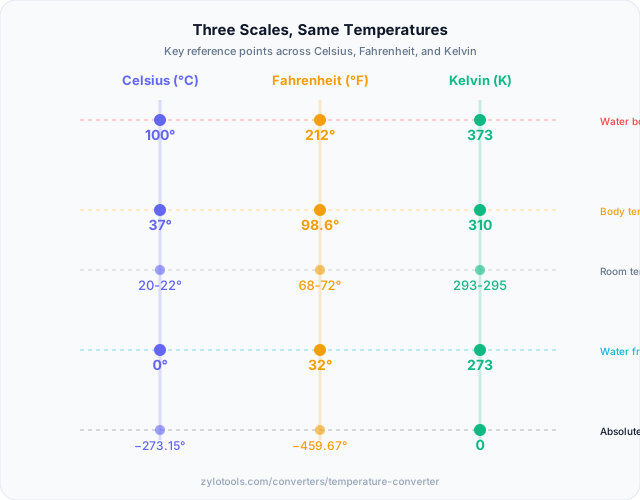
| Water freezes | 0 | 32 | 273 |
| Comfortable room | 21 | 70 | 294 |
| Normal body temp | 37 | 98.6 | 310 |
| Fever (mild) | 38 | 100.4 | 311 |
| Hot coffee | 60–70 | 140–160 | 333–343 |
| Water boils | 100 | 212 | 373 |
| Oven (moderate baking) | 180 | 350 | 453 |
| Oven (high heat roasting) | 220 | 425 | 493 |
A practical weather cheat sheet to tape somewhere in your brain:
- 0°C / 32°F — Freezing. Ice on the roads. Winter coat territory.
- 10°C / 50°F — Cool. Jacket weather. London in October.
- 20°C / 68°F — Pleasant. T-shirt and jeans. Perfect.
- 30°C / 86°F — Hot. Shorts, sunscreen, cold drinks.
- 40°C / 104°F — Dangerously hot. Stay indoors, hydrate aggressively.
Why Fahrenheit Isn't as Dumb as It Looks
If you grew up with Celsius, Fahrenheit probably seems arbitrary and confusing. Water freezes at 32°? Boils at 212°? Who decided those numbers?
But here's the thing — Fahrenheit wasn't designed around water. It was designed around human experience. And once you see it that way, it actually makes a weird kind of sense.
Consider this: the 0–100°F range roughly maps to "coldest to hottest temperatures a human regularly encounters outdoors." Zero Fahrenheit is bitterly cold (−18°C). One hundred Fahrenheit is oppressively hot (38°C). That gives you a full 100-point scale for describing weather that matters to people, without ever needing negative numbers for most inhabited places.
Celsius, by contrast, crams the "weather you'll actually experience" range into roughly −10 to 40 — just 50 degrees. Fahrenheit gives you double the resolution for the same span. When your thermostat goes from 68°F to 70°F, that's a noticeable difference in comfort. The Celsius equivalent (20°C to 21.1°C) doesn't express that nuance as cleanly in whole numbers.
None of this means Fahrenheit is better — Celsius is objectively more logical for science and international communication. But the next time someone mocks Fahrenheit as "random American nonsense," know that there's actual reasoning behind it. It's optimized for a different use case.
If you're working with conversions between measurement systems more broadly — weight, length, area — our unit conversion guide covers the same kind of practical tricks for all of them.
When You Actually Need Kelvin
Unless you work in a lab or took university-level physics, you might wonder why Kelvin exists at all. After all, you can just use Celsius and go negative when things get cold, right?
Not quite. Kelvin solves a specific problem that neither Celsius nor Fahrenheit can: it gives temperature a true zero. And that matters more than you'd think.
The Ratio Problem
Here's why Celsius breaks for science. Say it's 20°C today and 10°C yesterday. Is today "twice as warm"? Intuitively you'd say no — and you'd be right. In Kelvin, those temperatures are 293K and 283K. The ratio is about 1.035. Today is roughly 3.5% warmer in terms of actual thermal energy. Celsius's arbitrary zero point (water freezing) makes temperature ratios meaningless.
This matters for:
- Gas laws — The ideal gas law (PV = nRT) requires Kelvin. Using Celsius would produce nonsensical results at low temperatures.
- Thermodynamics — Entropy calculations, efficiency ratios, and energy transfer equations all demand an absolute scale.
- Astronomy — Stellar temperatures make more sense in Kelvin. Our Sun's surface is about 5,778K. The cosmic microwave background radiation is 2.7K.
- Color temperature — Photographers and display manufacturers describe light warmth in Kelvin. Candlelight is roughly 1,800K. Daylight is around 5,500K. The bluish glow of an overcast sky is 7,000K+.
Kelvin in Everyday Life (Sort Of)
You've probably encountered Kelvin without realizing it. "Warm white" LED bulbs are marketed as 2700K. "Daylight" bulbs are 5000K. This isn't random — it refers to the color temperature of light, describing what temperature a theoretical "black body" would need to be heated to in order to glow that color.
Beyond lighting, Kelvin shows up in weather science (atmospheric physics models), materials engineering (metal working temperatures), and even cooking science at the industrial level. But for your kitchen thermometer? Celsius or Fahrenheit will do just fine.
Speaking of measurements that seem overly complicated until you understand the context — if you've ever struggled with weight conversions between metric and imperial, or tried to figure out length conversions for an international purchase, the same "why are there multiple systems?" frustration applies.
The −40 Trick and Temperature Fun Facts
Every good measurement system has its quirks. Temperature scales have more than most. Here are the facts that make you the most interesting person at a dinner party (assuming a very specific kind of dinner party).
The −40° Crossover
There's exactly one temperature where Celsius and Fahrenheit produce the same number: −40°. Plug it into the formula and check: (−40 × 9/5) + 32 = −72 + 32 = −40. It works. It's the only crossover point. It's also extremely cold — this is "exposed skin freezes in minutes" territory, common in northern Canada, Siberia, and parts of Scandinavia in winter.
Travelers have used this as a sanity check for conversion formulas for decades. If your math gives you −40°C = −40°F, your formula is correct.
More Temperature Oddities
- Celsius almost went backwards. Anders Celsius originally proposed 0° for boiling and 100° for freezing. It was flipped after his death by Carl Linnaeus (yes, the botanist who named everything).
- The hottest recorded air temperature on Earth is 56.7°C (134°F), measured in Death Valley, California in 1913. Though some meteorologists dispute the measurement's accuracy.
- The coldest natural temperature on Earth was −89.2°C (−128.6°F), recorded at Antarctica's Vostok Station in 1983.
- "Room temperature" isn't universal. In the US, it typically means 68–72°F (20–22°C). In many tropical countries, "room temperature" is understood as 25–28°C (77–82°F) since that's what's normal without air conditioning.
- Your body temperature probably isn't 98.6°F (37°C). That number comes from a 1851 German study. Modern research suggests the average has dropped to around 97.9°F (36.6°C), possibly due to reduced inflammation rates in contemporary populations.
- Water doesn't always freeze at 0°C. Very pure water, if cooled carefully without disturbance, can remain liquid down to about −48°C (−55°F). This is called "supercooling." The moment you disturb it — tap the container, add a crystal — it flash-freezes instantly.
Temperature conversions become second nature once you have a few anchor points memorized. It's the same principle behind currency conversion when traveling — you don't convert every price, you learn a few benchmarks and estimate from there.
Frequently Asked Questions
How do you convert Celsius to Fahrenheit?+
Multiply the Celsius temperature by 9/5 (or 1.8) and then add 32. For example, 25°C becomes (25 × 9/5) + 32 = 77°F. If you need a quick mental estimate without pulling out a calculator, just double the Celsius number and add 30. It's not perfectly precise — you'll typically be off by a couple of degrees — but it's close enough for deciding whether you need sunscreen or a sweater.
What is absolute zero?+
Absolute zero is defined as 0 Kelvin, which equals −273.15°C or −459.67°F. It represents the theoretical point where all molecular motion stops and a substance would possess zero thermal energy. Scientists have gotten incredibly close to absolute zero in laboratory settings — within billionths of a degree — but truly reaching it is considered physically impossible because removing that last bit of energy would require infinite work.
Why does the US still use Fahrenheit?+
It's purely historical inertia. The United States adopted Fahrenheit early in its history, well before the metric system became the international standard. Congress passed the Metric Conversion Act in 1975 to encourage a voluntary transition, but widespread public resistance and the enormous cost of changing road signs, product labels, educational materials, and industrial equipment killed the momentum. The result is that the US, along with a handful of smaller nations like Belize and the Bahamas, continues using Fahrenheit for everyday temperature measurement.
Is there a temperature where Celsius and Fahrenheit are the same?+
Yes — exactly −40°. This is the sole point where both scales intersect. If you plug −40°C into the conversion formula (−40 × 9/5 + 32), you get −40°F. It's a mathematical consequence of the specific offset (32) and ratio (9/5) that define the relationship between the scales. This makes −40 a handy sanity check: if your conversion formula produces −40°C = −40°F, you know your math is correct.
What's the easiest way to convert temperatures quickly?+
For Celsius to Fahrenheit, double the number and add 30 — it's approximate but reliable enough for everyday decisions like choosing clothes or understanding a weather forecast. For Fahrenheit to Celsius, subtract 30 and halve it. If you memorize just a few anchor points (0°C = 32°F, 20°C = 68°F, 37°C = 98.6°F), you can estimate everything else from those landmarks. When you need exact precision — for cooking, science, or medical purposes — use our temperature converter tool and skip the mental arithmetic entirely.
Skip the Math Entirely
Done estimating? Our temperature converter handles all six conversion directions instantly — just type a number and pick your scales.
Convert Temperatures Now →Related Resources
If you found this guide useful, these related tools and articles might save you time too:
- Temperature Converter — Instant conversions between Celsius, Fahrenheit, and Kelvin
- Weight Converter — Kilograms, pounds, ounces, and more
- Length Converter — Meters, feet, inches, miles, and beyond
- Area Converter — Square feet, square meters, acres, hectares
- Currency Converter — Real-time exchange rates for international travel
- Complete Unit Conversion Guide — Mental math tricks for all measurement types
- BMI Calculator — Quick body mass index calculation
- Calorie Calculator — Daily caloric needs based on your activity level
- Calorie Counting Guide — Practical tips for tracking nutrition